

The process begins in May when students are asked to choose between self-funded and internships offered by the institution. I chose the internship offered by the university. I was overwhelmed and unsure of all that might have transpired. The college then placed me with Saath Charitable Trust, an Ahmedabad-based NGO to have an experiential learning journey. My journey of learning and self-development with Saath Charitable Trust began on the very first day I arrived at the Saath head office. I was presented to my mentors and teammates for the upcoming two months. I had no expectations and didn’t even know what to wish for.

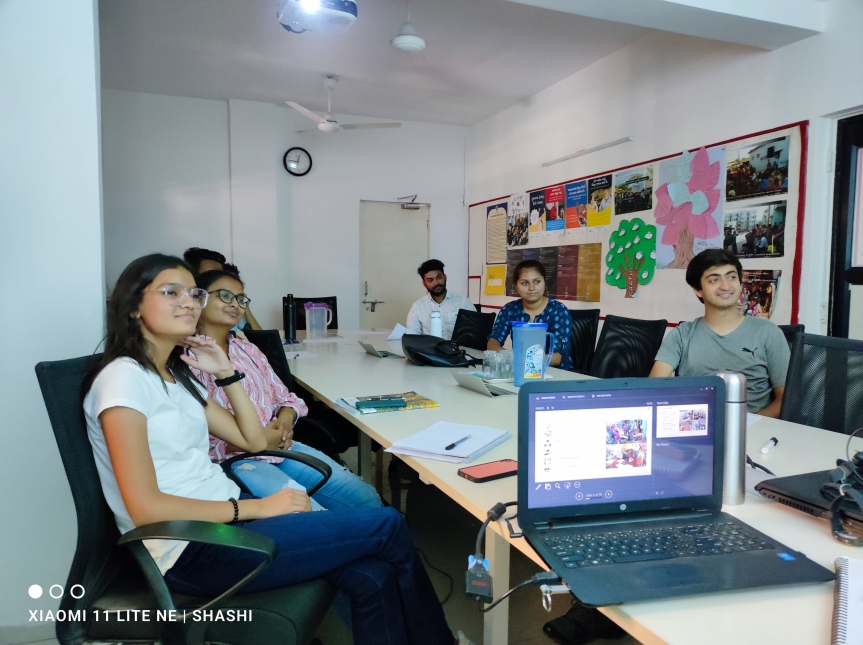
From knowing the superficial dynamics of the NGO to feeling like a member of their family, this is a story that really changed my perspective on life and had a huge impact. An orientation session had been planned for us by Shashi sir from the team Research, Documentation & Communication. Through this, we got to know the internal workings of all Saath programs. This was followed by an interesting self-introspection exercise through which we got to know more about ourselves as a human, our strengths, and our weaknesses. Although most NGOs are for the people of this world, there are few of them who actually understand their Corporate Social Responsibility and work for people rather than themselves. Saath Charitable Trust is an NGO based in Ahmedabad, Gujarat, and works primarily in Gujarat, parts of Rajasthan, Maharashtra, and Uttar Pradesh. It focuses on various sectors such as Healthcare, Education, Livelihoods, Women empowerment, Entrepreneurship, etc.

Saath Charitable Trust in my perspective is not an NGO or some organization. Saath is a vision that someday people, every single person in this world would start helping and taking an extra step for the betterment of society and they won’t need Saath, as an organization anymore. Upon the end of the orientation session, we were requested to have field visits to all the Saath programs and take practical learnings. This gave us information from the people who dedicate their lives to the upliftment of society. I got the opportunity to have direct interactions with communities for whom these programs were made and learned how Saath brought up a change in their life. We were then given time to analyze, research, and introspect our skills and curiosity to choose one of the Saath programs to work with. I was intrigued by one of the Saath programs named “Urmila” which trained women from rural areas who do not have a constant source of income and needed financial support. Thereafter they are placed as home managers to clients who can opt for daily household services on a fair, indiscriminate, and transparent wage for improving the woman’s life.

On my first day at Urmila Centre, I met Bella ma’am who supports Urmila centre. I got to know about all the work and procedures over there. Clients who need halftime or full-time home manager to take care of their household chores approach Urmila centre by filling out a registration form. Upon registering, one of the home managers is placed in their household. And they are introduced to a relationship manager who takes care of any concerns from both the home manager and the client side. In the days that followed, I went on field visits and met numerous home managers at their homes. I was curious about their life before joining Saath and how Saath has brought up a significant change financially, socially, and mentally.

I got to know about their life and their daily schedules. I observed that most of them came from a financially unstable background wherein they aspired in life that were unmet due to the denial of work by their family members and being overburdened with family responsibilities. These women feared talking to new people, wished to explore their city, be confident, and aspired to have an independent life. This is where Saath stepped in and gave them an opportunity to take charge of their lives.

In the informal world, they were unable to take timely leaves, often burdened with unpaid work, and many other problems prevailed. Saath through its Urmila Centre trains them for various household tasks such as operating electronics like washing machines, cooking special recipes, and taking care of elderly people & young children. Along with this, they are also presented with a buffet of opportunities and resources for the betterment of their lives. I also met relationship managers and clients to know their side of the story. The clients were highly satisfied with the service as they get timely replacements whenever their home manager has to go to her village to meet her family. The transparency of the Urmila program is something they agree can’t be found elsewhere. I was able to compile a few case studies from the information & data that I collected. Along with this, I did take photos and video documentation of my experience.

Post working with Urmila Centre, I was assigned to the Balghar program. This is an initiative for children aged between 3-5 years of age and acts as a play school for children before they join the school. There are various activities that children are made to participate in starting with reciting poems and religious prayers. This is followed by teaching them basic math counting and using pictorial and fun representations of animals, birds, and alphabets to learn from. Apart from this, they are also taught basic manners, how to maintain proper hygiene, etiquette, and monitored regularly to make sure they are taking a nutrition-rich diet.

Most of these children come from poor household families and their parents are daily wage workers. Since most of the parents of these children go out and work, they are unable to take care of their little ones. At such a young age, children grasp and learn a lot of new things and pick up new habits every day. It is necessary and very important to monitor and develop a healthy physical & mental routine for building up their immunity and intelligence. Hence with this motive, Balghar all around Ahmedabad rural areas have been established. By observing kids learning at this age, I truly understood the value of education and proper nutrition in our early life years. I also interviewed all the teachers who teach at different Balghars. I understood how Saath has improved their lives by providing a steady source of income for them so they can support their family. I formed several case studies on the lives of these teachers to better understand the efforts and dedication that goes into their work which turned out to be insightful for me.
There is a plethora of learnings I’ve gathered in this journey with Saath. Their working style and time-bound behaviour taught me to be punctual and it also helped me fix my sleep schedule which was insanely wrecked. Almost every event associated with Saath is done on the field we never sat in the office for anything except discussions. Waking up early and getting to the venue before 11:00 am every morning was certainly a task for me. I’ve always been this introverted silent kid who liked his own solitude and avoided social interaction. This opportunity of working with Saath as a group member got me accustomed to social interaction. Now, I feel even more confident while talking to people. Since most of us come from wealthy families and hardships aren’t very common for most of us, it can be difficult to understand them at times. However, through this internship, we learned how to handle difficulties by pushing through them and concentrating on our work. I came to understand the true significance of the proverb “Hardships are the participation credentials of adulthood”. This clearly illustrates that although we may have had difficulties, what matters is that we act, carried out our plans, and learned from the experience.

As the internship is ending, I can confidently make a commitment to myself that I will always act in a way that benefits people and recognize my obligation to not only my family and parents but to everyone else and every creature. I’d love to stay in touch with Saath and do whatever I can to promote their vision.
-Rohin Mehrotra





 SAATH
SAATH 